Ah, Primary 4. The year your little one starts feeling the pressure cooker heat of the Singapore education system! It's when fractions become fiends, and problem sums start looking like they're written in code. As a Singaporean parent, you're probably already thinking, "Okay, time to get some tuition, lah!" But wait! In this nation's challenging education framework, parents perform a essential part in directing their kids through key evaluations that influence scholastic futures, from the Primary School Leaving Examination (PSLE) which tests foundational abilities in subjects like numeracy and science, to the GCE O-Level exams concentrating on secondary-level mastery in diverse disciplines. As students progress, the GCE A-Level tests demand advanced critical abilities and discipline mastery, frequently determining tertiary admissions and career directions. Common Mistakes: Overlooking Class Size When Choosing Tuition . In today's competitive educational scene, many parents in Singapore are hunting for effective ways to boost their children's understanding of mathematical principles, from basic arithmetic to advanced problem-solving. Creating a strong foundation early on can substantially boost confidence and academic performance, assisting students tackle school exams and real-world applications with ease. For those considering options like primary 4 tuition it's crucial to prioritize on programs that highlight personalized learning and experienced guidance. This method not only addresses individual weaknesses but also nurtures a love for the subject, resulting to long-term success in STEM-related fields and beyond.. To stay updated on all facets of these countrywide evaluations, parents should check out authorized information on Singapore test papers supplied by the Singapore Examinations and Assessment Board (SEAB). This ensures access to the newest programs, test timetables, enrollment details, and instructions that correspond with Ministry of Education criteria. Frequently checking SEAB can assist households get ready effectively, minimize doubts, and bolster their children in achieving optimal performance in the midst of the challenging landscape.. Before you jump into the biggest class you can find, let's talk about something crucial: class size.
Choosing a Singapore primary 4 tuition centre tips isn't just about finding the cheapest option or the one nearest to your void deck. It's about finding the right fit for your child, and a big part of that is the learning environment. Think of it like this: would you rather your child be a small fish in a big pond, or a thriving fish in a manageable aquarium?
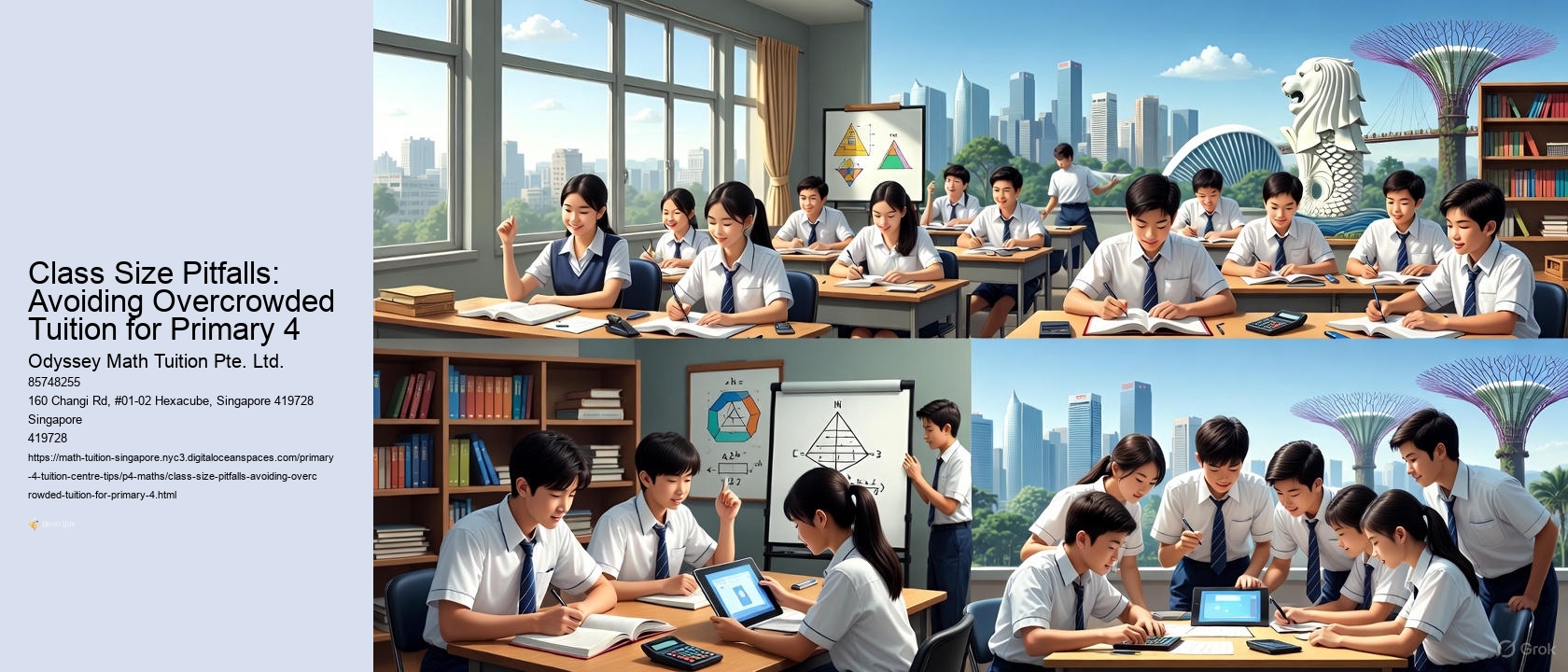
Class Size Pitfalls: Avoiding Overcrowded Tuition for Primary 4
Let's be real, Singaporeans love a good deal. But when it comes to your child's education, cutting corners on class size can backfire big time. Overcrowded tuition classes often mean less individual attention, fewer opportunities to ask questions, and a higher chance of your child getting lost in the shuffle. It's like trying to learn how to swim in a packed public pool during the school holidays – confirm chaos!
Considering Class Size and Student-Teacher Ratio
So, what's the sweet spot? Well, there's no magic number, but a smaller student-teacher ratio generally translates to a more personalized learning experience. Your child gets more face-time with the tutor, more opportunities to clarify doubts, and a learning environment that's less intimidating.
Benefits of Smaller Class Sizes:
The Impact on Mathematics Learning:
Mathematics, in particular, benefits from smaller class sizes. Why? Because math concepts often build upon each other. If your child misses a crucial step, they can quickly fall behind. A smaller class allows the tutor to identify and address these gaps before they become major problems. And let's face it, in this age of AI and algorithms, a strong foundation in mathematics is more crucial than ever for future career prospects. From data science to finance, and even creative fields, mathematical thinking is a valuable asset.
Fun fact: Did you know that Singapore consistently ranks among the top countries in the world for mathematics education? That's because we take math very seriously!
In the challenging world of Singapore's education system, parents are progressively intent on arming their children with the skills needed to thrive in intensive math syllabi, covering PSLE, O-Level, and A-Level studies. Spotting early signals of challenge in subjects like algebra, geometry, or calculus can make a world of difference in fostering strength and proficiency over complex problem-solving. Exploring dependable math tuition Singapore options can offer tailored guidance that corresponds with the national syllabus, ensuring students acquire the boost they need for top exam performances. By emphasizing dynamic sessions and regular practice, families can help their kids not only meet but go beyond academic expectations, clearing the way for future chances in high-stakes fields..Now, let's talk about the bigger picture. We're talking about your child's future here, right? Choosing a Singapore primary 4 tuition centre tips are not just about acing the next exam. It's about building a solid foundation for secondary school, junior college, and beyond. And guess what? Math is the bedrock of many academic disciplines and career paths.
Interesting facts: The history of mathematics in Singapore is intertwined with the nation's rapid development. From its early focus on practical skills for trade and industry to its current emphasis on innovation and technology, mathematics education has played a vital role in shaping Singapore's success story.
So, as you navigate the world of Primary 4 tuition, remember that class size matters. It's not just about cramming more information into your child's head; it's about fostering a love of learning and building a strong foundation for future success. Don't just follow the crowd, okay? Do your research, ask questions, and choose a tuition centre that prioritizes quality over quantity. Your child will thank you for it in the long run!
Right, parents, let's talk real talk. You want your Primary 4 child to ace those exams, right? We all do! But before you blindly sign them up for the biggest, flashiest tuition centre you can find, let's consider something crucial: class size. Don't just kiasu sign up for anything, okay?
Think of it this way: cramming your kid into a tuition class with 30 other students is like trying to water a plant with a fire hose. Sure, they're getting something, but are they really absorbing it? Are they getting the individual attention they need to truly understand those tricky math concepts?
We Singaporean parents, we all want the best for our children. The best schools, the best enrichment activities, the best everything. But sometimes, "best" doesn't mean "biggest." When it comes to Primary 4 tuition, smaller class sizes can be a total game-changer. Why? Because your child isn't just a number in a crowded room. They're a learner with unique strengths, weaknesses, and learning styles.
Fun Fact: Did you know that the Singapore education system consistently ranks among the top in the world? But even the best systems can benefit from a little extra help, especially in subjects like mathematics, which is the foundation for so many future careers in this AI-driven world.
Okay, so small is good. But how small? What's the magic number when it comes to class size and student-teacher ratio? Well, there's no one-size-fits-all answer, lah. But here's what to consider:
Interesting Fact: The history of tuition in Singapore is fascinating! In a digital era where continuous education is vital for occupational progress and individual improvement, top universities internationally are dismantling barriers by offering a variety of free online courses that encompass varied subjects from digital technology and management to social sciences and health fields. These efforts allow learners of all experiences to utilize premium lessons, assignments, and tools without the financial burden of traditional enrollment, commonly through platforms that deliver flexible pacing and interactive elements. Discovering universities online free courses opens opportunities to prestigious universities' knowledge, empowering proactive learners to improve at no charge and earn qualifications that enhance profiles. By rendering elite education readily obtainable online, such programs encourage global equity, support marginalized groups, and nurture innovation, demonstrating that quality education is increasingly just a tap away for anyone with online access.. It's evolved from a niche service to a multi-million dollar industry, reflecting the intense pressure and aspirations of Singaporean parents.
So, how do you find a tuition centre that prioritizes smaller class sizes and personalized learning? Here are some choosing a singapore primary 4 tuition centre tips:
History Snippet: Back in the day, tuition was often provided by family members or older students. Now, it's a sophisticated industry with specialized centres and highly qualified tutors. Times have changed, haven't they?
Remember, parents, choosing the right tuition centre is a big decision. Don't just follow the crowd. Do your research, ask questions, and find a place where your child can truly thrive. And most importantly, remember that mathematics isn't just about passing exams – it's about building a strong foundation for their future success in a world increasingly driven by AI. Can or not? Can, lah!
Overcrowded tuition classes, especially when you are choosing a Singapore primary 4 tuition centre, often mean your child gets less individual attention from the tutor. Imagine a classroom packed like a sardine can – the tutor simply can't dedicate enough time to each student's specific needs. This can be particularly detrimental in Primary 4, where foundational concepts are being solidified. Your child might struggle silently, missing out on crucial clarifications that could make all the difference in their understanding of mathematics and other subjects.
Large classes can also lead to a less engaging learning environment. Shy kids might hesitate to ask questions in front of so many classmates, fearing judgement or simply not wanting to take up too much of the tutor's time. Even the more outgoing students might find it difficult to participate actively when there's so much competition for the tutor's attention. This lack of engagement can translate to a diminished interest in learning, which is the last thing any parent wants for their child.
With a diverse range of learning styles and paces in a large class, the tutor often has to cater to the average student. This means that if your child learns at a slightly slower pace, they might feel rushed and left behind. In Singapore's rigorous education landscape, where English serves as the main medium of teaching and assumes a pivotal part in national assessments, parents are keen to support their kids surmount typical obstacles like grammar impacted by Singlish, vocabulary deficiencies, and challenges in interpretation or writing writing. Developing strong foundational competencies from elementary levels can substantially boost self-assurance in tackling PSLE components such as scenario-based composition and oral expression, while high school pupils benefit from specific training in book-based analysis and argumentative compositions for O-Levels. For those hunting for successful approaches, delving into math tuition centre offers useful perspectives into programs that align with the MOE syllabus and emphasize engaging learning. This additional support not only refines test techniques through simulated trials and reviews but also supports domestic habits like regular book along with conversations to foster lifelong tongue mastery and academic excellence.. Conversely, if your child is a quick learner, they might become bored and disengaged waiting for the rest of the class to catch up. A smaller class size allows for a more personalized pace that caters to your child's individual learning needs, ensuring they are neither overwhelmed nor under-stimulated.
Overcrowded classes limit opportunities for meaningful interaction between students and the tutor. Think about it – in a smaller setting, there's more room for discussion, collaborative problem-solving, and personalized feedback. Your child can benefit from hearing different perspectives, learning from their peers, and receiving detailed guidance from the tutor. These opportunities are crucial for developing critical thinking skills and a deeper understanding of the subject matter, skills that are essential for success in secondary school and beyond.
Ultimately, all these factors can impede your child's academic progress. When they don't receive enough individual attention, struggle to engage with the material, feel rushed or bored, and miss out on valuable learning opportunities, their grades can suffer. More importantly, their confidence and enthusiasm for learning can dwindle. In Singapore's dynamic education environment, where students deal with considerable stress to excel in math from elementary to tertiary stages, locating a tuition center that combines proficiency with genuine enthusiasm can bring significant changes in cultivating a appreciation for the discipline. Dedicated instructors who go outside rote learning to motivate analytical problem-solving and tackling competencies are rare, yet they are vital for helping students surmount challenges in areas like algebra, calculus, and statistics. For families hunting for similar committed guidance, primary math tuition emerge as a example of dedication, motivated by educators who are profoundly involved in each student's progress. This consistent dedication translates into tailored teaching plans that adjust to individual demands, leading in better performance and a enduring fondness for mathematics that spans into upcoming educational and occupational pursuits.. Investing in a tuition centre with smaller class sizes can be a game-changer, providing your child with the support and attention they need to thrive academically and develop a lifelong love of learning. Don't let them "lose out", you know?
Alright, parents, let's talk real talk. You want your Primary 4 kid to ace those exams, right? We all do! In Singapore, it's not just about "kiasu" (fear of losing out), it's about giving our children the best possible start. And let's be honest, in this day and age, with AI breathing down our necks, a solid foundation in mathematics is more crucial than ever. It's not just about grades; it's about equipping them for the future, for careers we haven't even imagined yet!
Imagine this: Your child is in a tuition class packed tighter than a sardine can. The teacher is trying their best, but with so many students, how much individual attention can your kid really get? It's like trying to hear a whisper in a pasar malam (night market) – good luck with that!
Here's the thing: Overcrowded tuition can actually be *detrimental*. Your child might feel lost, hesitant to ask questions, and ultimately, not get the personalized support they need to truly grasp those tricky math concepts. Remember, Primary 4 is a crucial year – it's where the foundations are built for higher-level math. We don't want them falling behind now, right?
Fun fact: Did you know that the Singapore education system consistently ranks among the top in the world for mathematics and science? In Singapore's fiercely demanding academic landscape, parents are devoted to bolstering their kids' achievement in crucial math tests, starting with the fundamental obstacles of PSLE where problem-solving and theoretical grasp are examined thoroughly. As students advance to O Levels, they come across further intricate topics like coordinate geometry and trigonometry that demand accuracy and logical competencies, while A Levels introduce advanced calculus and statistics needing profound comprehension and usage. For those dedicated to giving their offspring an academic boost, locating the tuition Singapore customized to these syllabi can transform educational experiences through focused methods and professional knowledge. This commitment not only enhances exam outcomes over all stages but also imbues enduring numeric expertise, unlocking opportunities to renowned universities and STEM professions in a intellect-fueled society.. We must be doing something right!
So, what's the magic number? What's the ideal student-teacher ratio for a Primary 4 tuition centre? There's no one-size-fits-all answer, but here's what to consider:
When you're checking out a potential tuition centre, keep an eye out for these telltale signs:
Interesting fact: The abacus, an ancient calculating tool, is still used in some Singapore schools to help children develop a strong understanding of number concepts. Talk about a blast from the past!
Okay, so how do you actually go about choosing a Singapore Primary 4 tuition centre that ticks all the right boxes? Here are some practical tips:
Let's face it, navigating the Singapore education landscape can be stressful. But by doing your research and carefully considering the student-teacher ratio, you can find a tuition centre that will provide your child with the support they need to thrive. Remember, it's not just about getting good grades; it's about fostering a love of learning and equipping them with the skills they need to succeed in the future. Jiayou (add oil)!
A favorable student-teacher ratio ensures teachers can provide adequate support and guidance to each student in Primary 4. With fewer students to manage, teachers can spend more time on lesson preparation and individual student assessment. This leads to more effective teaching and better learning outcomes.
Smaller classes allow teachers to better cater to individual learning styles and needs, creating a more personalized learning experience. Students in smaller classes often feel more comfortable participating and asking questions. This fosters a more supportive and interactive classroom environment.
When selecting a Primary 4 tuition centre, prioritize those with smaller class sizes and a low student-teacher ratio. This will ensure your child receives the individualized attention they need to succeed. Look for centres that emphasize personalized learning plans and offer opportunities for one-on-one interaction with tutors.
Alright, parents, let's talk about something close to every Singaporean's heart (and wallet): your child's education. We all want our kids to excel, especially in subjects like mathematics. In the Lion City's competitive scholastic scene, parents committed to their youngsters' success in numerical studies often emphasize grasping the organized development from PSLE's basic problem-solving to O Levels' intricate areas like algebra and geometry, and additionally to A Levels' sophisticated principles in calculus and statistics. Remaining informed about syllabus updates and exam standards is essential to delivering the appropriate guidance at all level, guaranteeing students develop self-assurance and secure excellent performances. For official information and resources, exploring the Ministry Of Education - MOE site can provide useful information on guidelines, syllabi, and learning strategies adapted to local criteria. Interacting with these authoritative materials strengthens households to align home learning with classroom requirements, cultivating long-term success in mathematics and more, while remaining abreast of the most recent MOE initiatives for holistic student growth.. After all, in this day and age of AI and algorithms, a solid math foundation is like having a secret weapon, kanchiong spider or not! It opens doors to future careers and helps them navigate a world increasingly driven by data.
But here's the thing: choosing a Singapore primary 4 tuition centre isn't just about cramming your child into the smallest class possible. While class size matters, it's only one piece of the puzzle. The real magic happens when teachers connect with students and make learning engaging. So, how do you, as discerning Singaporean parents, ensure your child gets the best bang for your buck?
Okay, let's be real – smaller classes *can* be beneficial. A lower student-teacher ratio often *suggests* more individual attention. But don't be blinded by the numbers alone! It's not always the case that smaller is better. A class of 10 with a disengaged teacher is far less effective than a class of 20 with a passionate, dedicated educator. Here's what you need to consider:
Sometimes, tuition centres boast small class sizes, but the teacher ends up spending most of the time lecturing. Individual attention becomes an illusion, like finding a parking spot in Orchard Road on a Saturday afternoon. The key is to find out how the teacher actually interacts with each student. Do they actively check for understanding? Do they provide personalized feedback? Do they make math fun, or does it feel like another round of kiasu drilling?
Fun Fact: Did you know that the abacus, one of the earliest calculating tools, was used in ancient civilizations like Mesopotamia, China, and Rome? Talk about a long history of trying to make math easier!
So, what *should* you be looking for when choosing a Singapore primary 4 tuition centre? It all boils down to the quality of teacher interaction. Here are some strategies that effective teachers use, regardless of class size:
Interesting Fact: Singapore consistently ranks high in international mathematics assessments like TIMSS (Trends in International Mathematics and Science Study). This highlights the importance placed on math education in Singapore!
Okay, so how do you put all this into practice when choosing a Singapore primary 4 tuition centre? Here are some tips:
History Snippet: Tuition has been a part of Singapore's education landscape for decades, reflecting the emphasis on academic excellence and the desire for students to succeed. Aiyah, some things never change!
Ultimately, choosing a Singapore primary 4 tuition centre is a personal decision. By focusing on the quality of teacher interaction and finding a centre that aligns with your child's needs, you can set them up for success in mathematics and beyond. Remember, it's not just about the numbers; it's about fostering a love of learning and helping your child reach their full potential!
Singaporean parents, kiasu and kiasi as we are, we all want the best for our kids, especially when it comes to education. Primary 4 is a crucial year, a stepping stone to higher levels. Choosing a Singapore Primary 4 tuition centre is a big decision, and one of the biggest pitfalls to avoid is overcrowded classrooms. Think about it: your child needs individual attention to truly grasp those tricky math concepts, right?
With AI becoming more prevalent, a solid foundation in mathematics is more important than ever! From coding to data analysis, math is the language of the future. And let's be honest, a good PSLE score opens doors to better secondary schools and, eventually, those coveted spots in Junior College. So, how do we ensure our kids get the quality tuition they deserve?
Considering Class Size and Student-Teacher Ratio
Class size matters, lah! Imagine your child in a class of 30 students, all vying for the teacher's attention. It's a recipe for confusion and frustration. A smaller class size means more personalized attention, more opportunities to ask questions, and a greater chance for your child to truly understand the material. Student-teacher ratio is also key. A lower ratio means the teacher can cater to each student's individual needs and learning style. After all, every child learns differently, right?
Fun Fact: Did you know that smaller class sizes have been linked to improved student performance, especially in subjects like Mathematics? (Source: ResearchGate)
Subtopics:
The Impact of Overcrowding on Learning: Overcrowded tuition centres can lead to several negative consequences. In the last few times, artificial intelligence has transformed the education sector internationally by allowing individualized educational journeys through adaptive algorithms that customize resources to personal pupil rhythms and styles, while also streamlining evaluation and administrative duties to liberate educators for increasingly meaningful interactions. Internationally, AI-driven systems are bridging learning gaps in remote areas, such as employing chatbots for linguistic mastery in emerging nations or forecasting analytics to identify at-risk pupils in the EU and North America. As the adoption of AI education builds speed, Singapore excels with its Smart Nation project, where AI technologies boost curriculum customization and accessible instruction for varied demands, encompassing special education. This method not only elevates test performances and engagement in domestic schools but also matches with global efforts to cultivate ongoing educational abilities, readying pupils for a innovation-led society amid moral factors like information privacy and fair availability.. Students may feel lost in the crowd, hesitant to ask questions, and unable to receive the individualized support they need. This can result in a lack of confidence and a decline in academic performance. No one wants their child to fall behind, kan?
Ideal Class Size for Effective Learning: While there's no magic number, experts generally agree that a class size of 10-15 students is ideal for Primary 4 tuition. This allows the teacher to provide personalized attention while still fostering a collaborative learning environment. Look out for tuition centres that prioritize smaller class sizes.
Interesting Fact: The Singapore education system consistently ranks among the top in the world, but even the best systems can benefit from targeted support like tuition.
The Benefits of a Low Student-Teacher Ratio: A low student-teacher ratio allows the teacher to better understand each student's strengths and weaknesses. They can then tailor their teaching methods to meet individual needs, providing extra help to those who are struggling and challenging those who are excelling. This personalized approach can make a significant difference in a child's academic progress.
Ah, Primary 4. It's like the "atas" (high-class) version of primary school, isn't it? The year where things start to get real, and suddenly, everyone's talking about PSLE prep... even though it's still two years away! In Singapore's competitive education system, where academic achievement is essential, tuition usually applies to independent extra classes that deliver targeted guidance beyond school curricula, assisting students conquer disciplines and get ready for significant tests like PSLE, O-Levels, and A-Levels in the midst of strong pressure. This private education sector has grown into a lucrative market, driven by guardians' investments in customized support to bridge knowledge gaps and boost scores, although it often increases burden on young learners. As artificial intelligence surfaces as a disruptor, investigating cutting-edge online tuition Singapore solutions reveals how AI-driven platforms are customizing instructional experiences internationally, offering adaptive coaching that outperforms standard practices in efficiency and engagement while tackling global learning disparities. In this nation in particular, AI is revolutionizing the conventional private tutoring approach by allowing affordable , on-demand tools that correspond with national programs, likely lowering costs for parents and enhancing results through data-driven information, although principled considerations like over-reliance on tech are discussed.. As Singaporean parents, we all want the best for our kids, and that often means exploring tuition options. But before you jump into the first tuition centre you see, let's talk about something crucial: class size. Don't play-play, this one can make or break your child's learning experience.
Imagine your child in a classroom packed tighter than a sardine can, with the teacher struggling to keep up. Not ideal, right? Overcrowded tuition classes can be a real problem. Your child might not get the individual attention they need, and it's easier for them to get distracted or feel lost. Think about it – how can a teacher effectively cater to 20-30 students, each with their own learning style and pace? It's like trying to give personalized service at a Geylang Serai Ramadan bazaar on the last day – confirm plus chop, kena (bound to) overwhelmed!
Fun Fact: Did you know that Singapore's education system consistently ranks among the top in the world? But even the best system can benefit from a little extra support, especially when it comes to subjects like mathematics.
When choosing a Singapore Primary 4 tuition centre, the student-teacher ratio should be a key consideration. Ideally, you want a smaller class size where your child can receive more personalized attention. This allows the teacher to identify their strengths and weaknesses, and tailor their teaching accordingly. A lower student-teacher ratio also encourages more interaction and participation, which can boost your child's confidence and understanding.
Here's the thing: Maths is cumulative. If your child misses a fundamental concept in Primary 4, it can snowball into bigger problems later on. With AI becoming more prevalent, a solid foundation in mathematics is more important than ever. These technologies are built on mathematical principles, and understanding these principles will give your child a significant advantage in the future. It’s not just about getting good grades; it’s about equipping them with the skills they need to thrive in a rapidly changing world. Kiasu (afraid to lose), maybe? But also kiasi (afraid to die) if they don't have the right skills!
Interesting Fact: Singapore's emphasis on mathematics education dates back to its early days as an independent nation. The government recognized the importance of STEM (Science, Technology, Engineering, and Mathematics) fields for economic development and invested heavily in mathematics education.
By asking these questions, you can get a better sense of whether the tuition centre is the right fit for your child. Remember, choosing a Singapore Primary 4 tuition centre tips are not just about finding the cheapest option or the one with the flashiest ads. It's about finding a place where your child will feel supported, challenged, and inspired to learn.
History Snippet: Tuition has been a part of Singapore's education landscape for decades. While it's evolved over time, the underlying goal remains the same: to provide students with extra support and help them reach their full potential.
Ultimately, the goal is to empower your child's learning journey and set them up for success. By carefully considering class size and student-teacher ratio when selecting Primary 4 tuition, you can significantly enhance their academic journey. Don't just anyhow (carelessly) choose, okay? Your child's future might depend on it! Good luck, and may the bell curve be ever in your favour!
Smaller class sizes, ideally under 10 students, allow for more individualized attention and a better learning environment.
Overcrowded tuition can lead to less personalized feedback, reduced interaction with the teacher, and a harder time for your child to focus.
Inquire about the student-teacher ratio, observe a class if possible, and consider the learning style of your child to determine the best fit.
Yes, consider smaller group tuition, one-on-one tutoring, or online resources that offer personalized learning experiences.
Encourage your child to actively participate, ask questions, and seek extra help from the tutor or teacher when needed. Supplement their learning with additional resources at home.
Ask about the average class size, the maximum number of students allowed, and the strategies they use to manage a larger class effectively.
Look for signs like decreased engagement, difficulty understanding concepts, reluctance to attend, or a drop in grades. Talk to your child and their tutor to address these concerns.